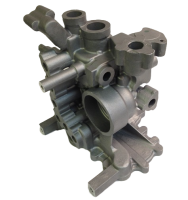

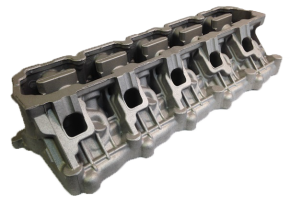

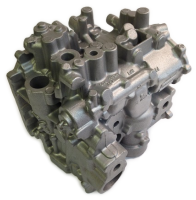

 Ohio Aluminum Industries is able to quickly provide prototype castings and/or plastic models to service our customers. We are experienced with the use of sand-printed or "grown" cores and 3D printing. We also make prototype castings the old fashioned way using low cost prototype tooling. Customer service is important to us. Accordingly, we strive to provide your prototypes on-time and on budget.
Sand Printed Cores
"Digital production of sand molds and cores eliminates the need for hard tooling and drastically reduces lead times. The process uses three-dimensional printing technology to produce the molds and cores layer by layer from a CAD file. A binder catalyst is coated on the sand which is then spread in layers. The printhead jets a second component of the binder system selectively onto the spread sand layer. When this component meets the catalyst coating on the sand, a polymerization reaction occurs which bonds the sand particles together. Curing occurs in the air without the need for external heat.
Standard foundry industry materials are used, enabling easy integration of the molds and cores into existing manufacturing and foundry procedures. This digital process offers design freedoms not possible in molds and cores produced using the traditional pattern approach. Castings requiring multiple cores can be modified to use fewer cores, or even a single core. Drafts required when molds are created from patterns can be eliminated. Advanced venting schemes and integrated rigging features are also possible.
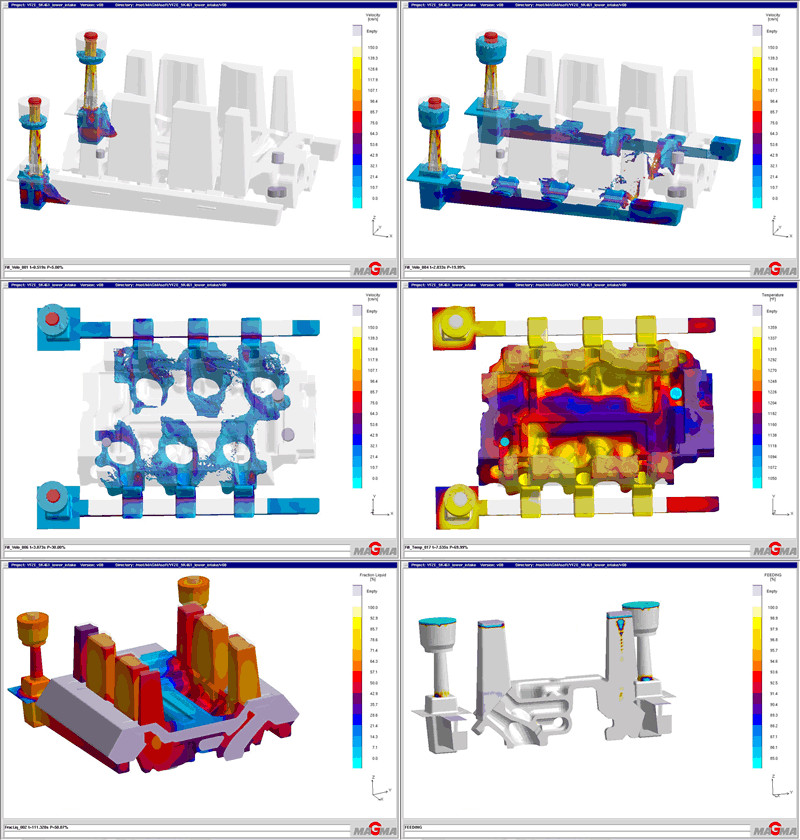
Multiple add-on service options are offered including reverse engineering, mold design, solidification analysis and CAD rigging system design, pouring of castings and inspection to ensure a quality finished product." - from http://www.exone.com